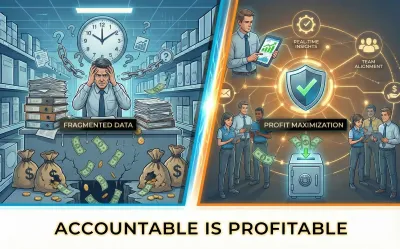
Food retail does not fail because operators lack effort. It fails because small, repeated operational inaccuracies compound faster than profits can absorb them.
Industry data makes this unavoidable. The Food Marketing Institute reports average net profit margins for U.S. grocery at ~1.7% in recent years. On $10 million in annual sales, that equates to roughly $170,000 in net profit. In that environment, losses measured in tens of thousands of dollars are not tolerable—they are existential.
This article lays out, using published industry benchmarks and real operational math, why grocery profitability depends on accountability across the full operating lifecycle—and why rigid systems are no longer optional.
The Structural Problem: Thin Margins × Massive Repetition
A typical $10M grocery store processes:
Transactions/Year
Every transaction is an opportunity for error or accuracy
Items Scanned/Year
Pricing accuracy matters at this scale
Vendor Spend (COGS)
Where invoice and receiving accuracy directly impacts margin
At that scale, minor error rates become major dollar losses. Grocery does not lose money in one dramatic failure. It loses money quietly, repeatedly, and systematically—when operations cannot be verified end-to-end.
Core Principle:
That is the context for the principle Accountable is Profitable.
Where the Money Actually Leaks (With Benchmarks)
1. Ordering the Wrong Items or Quantities (Stockouts)
Research firm IHL Group has consistently quantified out-of-stocks as a ~3.2% drag on retail sales in North America.
This is not theoretical. When inventory records are inaccurate or demand signals are delayed, shelves go empty on high-velocity items while capital sits elsewhere.
2. Buying What Does Not Sell (Overstocks and Dead Inventory)
The same IHL research estimates overstocks at ~3.0% of sales.
Stockouts and overstocks are two sides of the same failure: the store does not trust its on-hand, cost, or movement data enough to buy correctly.
3. Receiving Inaccuracies and Operational Shrink
The National Retail Federation reports average retail shrink at approximately 1.6% of sales. Importantly, NRF data shows that about 35% of shrink is not theft, but process failures, administrative errors, and damage.
Receiving errors are a key contributor here. When deliveries are not verified against purchase orders—and later reconciled against invoices—inventory and cost data become unreliable. Once that happens, every downstream decision degrades.
4. Invoice and Payment Errors
Accounts payable benchmarking from APQC (summarized by multiple finance benchmarking publications) shows that even top-performing organizations experience ~0.8% of annual disbursements as duplicate or erroneous payments, with weaker performers closer to 2%.
These are not fraud numbers; they are process numbers. They exist because invoices are often reviewed without verified receiving and item-level cost confirmation.
5. Pricing Errors at the Register
Pricing accuracy is another high-volume risk. The U.S. Federal Trade Commission's multi-state scanner pricing study found a 4.82% total item error rate, with 2.58% of items undercharged.
The exact dollar loss depends on item mix, but the conclusion is clear: pricing integrity is a systems problem, not a training problem.
The Unavoidable Conclusion from the Math
Put the benchmarks next to the profit reality:
| Category | Annual Impact |
|---|---|
| Net Profit on $10M Sales (~1.7%) | ~$170,000 |
| Stockouts (lost revenue opportunity) | ~$320,000 |
| Overstocks (tied-up capital, markdowns, spoilage) | ~$300,000 |
| Process-driven shrink | ~$56,000 |
| AP payment errors | $56,000–$140,000 |
| Pricing undercharges | Tens of thousands of transactions |
The Reality:
A grocery store does not need to be "badly run" for these losses to occur. It only needs disconnected systems.
Why Rigid Systems Change the Outcome
Rigid does not mean inflexible. It means verifiable.
A rigid operating system enforces a closed loop:
Purchase Order → Receiving → Invoice → Payment → Sale
When that loop is enforced:
Pay Only for What You Received
Every invoice is validated against verified receiving records before payment is approved.
Inventory Reflects Physical Reality
On-hand counts match what was actually received—not estimates or assumptions.
Cost Changes Detected Immediately
When vendor costs change, you know in real-time—not weeks later when margin damage has compounded.
Retail Prices Adjust Before Damage
Pricing updates flow through to registers before margin erosion becomes permanent.
Exceptions Surface Automatically
Problems don't hide in volume. The system flags discrepancies, short shipments, and anomalies the moment they occur—instead of discovering them during a quarterly review.
This is not about reporting. It is about preventing losses before they become permanent.
A Real-World Result: What Accountability Changed for Us
In the grocery store where UniSight was battle-tested in live operations, implementing a rigid, end-to-end operating system produced a result that speaks for itself:
Increase in Net Profit
From implementing rigid, end-to-end operating system
Traffic or Price Increases
Result came entirely from operational accountability
This was not driven by higher traffic or higher prices. It came from:
- Eliminating overbilling and invoice discrepancies
- Detecting cost changes immediately and adjusting pricing faster
- Reducing inventory distortion (both stockouts and overstocks)
- Restoring trust in inventory and financial data
Note:
This is a case-study result, not a universal promise. But it aligns precisely with what industry benchmarks predict: when leakage exceeds profit, eliminating leakage multiplies profit.
What "Accountable is Profitable" Actually Proves
Accountable is Profitable is not a slogan. It is a statement about cause and effect in a low-margin, high-volume business:
The Chain of Causation
- 1. When operations are accountable → costs are real-time
- 2. When costs are real-time → pricing is defensible
- 3. When pricing is defensible → margins stop leaking
- 4. When margins stop leaking → profit reappears
In grocery, profitability is not created by optimism or effort. It is created by systems that force the truth to surface early.
The Bottom Line:
That is why no modern food retailer can afford to operate without a rigid operations platform—and why accountability, quite literally, becomes profit.
Ready to make your operations accountable?
UniSight provides the rigid, end-to-end operating platform that turns accountability into profit.
Request a Demo