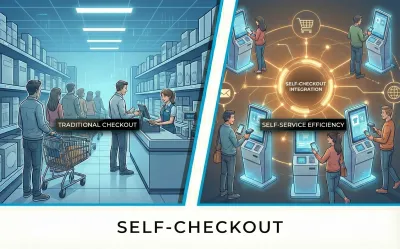
Promise vs. Reality
For decades, self-checkout (SCO) was presented as the future of retail: a way to cut labor costs, speed up lines, and empower customers. This section explores the wide gap between those initial expectations and the complex, often costly, reality that grocery stores are now facing.
The Promise
→ Drastic Labor Cost Reduction
The primary driver. The model was that one employee could supervise 4-6 kiosks, replacing multiple highly-paid cashiers.
→ Increased Speed and Convenience
Appeal to busy "grab-and-go" shoppers, reduce overall wait times, and efficiently handle peak-hour rushes.
→ Customer Empowerment
Allow customers more control, privacy (especially for sensitive items), and autonomy over their shopping experience.
The Reality
→ Massive Increase in Shrink
Theft and errors skyrocketed. SCO lanes have a shrink rate of 3.5-4%, compared to less than 1% at staffed registers, wiping out profit margins.
→ Hidden Costs and Labor
Kiosks require constant maintenance, expensive software, and 1-2 attendants to fix errors, check IDs, and deter theft—negating savings.
→ Customer Frustration
Frequent technical glitches ("Unexpected item in bagging area"), full-cart bottlenecks, and impersonal service angered many customers.
Why Do Shoppers Use It?
Despite the issues, many customers do prefer self-checkout. The primary stated reason is speed, even if it's only a perception.
For Speed
The primary reason shoppers choose self-checkout
Other Reasons
Shorter lines, privacy, autonomy
The Cost Equation
The business case for self-checkout was built on a simple calculation: labor savings > technology cost. However, the "technology cost" proved to be a complex, recurring, and escalating variable that many retailers underestimated.
The True Cost of a Single Kiosk
The cost of self-checkout extends far beyond the initial purchase. Here's the true cost breakdown:
Upfront Costs
- Basic Kiosk: $8,000
- Advanced Kiosk (AI, Scales): $20,000
Annual Recurring Costs
- Basic Maintenance: $1,500/year
- Advanced Maintenance: $3,000/year
- AI Software (per kiosk): $2,400/year
The Labor Savings Myth
The expectation of eliminating cashier roles was quickly proven false. Stores cannot leave kiosks unattended due to:
- Constant Errors: Over 57% of users require employee assistance due to weight scale errors, coupon issues, or general confusion.
- Age Verification: An attendant must be present to check IDs for alcohol, tobacco, and other restricted items.
- Theft Deterrence: The mere presence of an attentive employee is the single biggest deterrent to "skip-scanning."
Ultimately, labor costs were not eliminated but redeployed from "cashier" to "SCO attendant," a role that is often more stressful and requires more technical troubleshooting.
The Shrink Problem
"Shrink" is the retail term for inventory loss due to theft, error, or damage. In the grocery industry, which operates on razor-thin 1-3% profit margins, the explosion in shrink at SCOs is not just a cost—it's an existential threat to profitability.
Shrink Rate: SCO vs. Staffed Lane
This is the core of the problem. Self-checkout lanes lose 7-10 times more revenue to shrink than traditional cashiers.
Staffed Cashier Lane
Typical shrink rate with human cashiers
Self-Checkout Lane
Average shrink rate at SCO (3.5-4%)
of Total Unknown Loss
One study found that self-checkouts accounted for nearly a quarter of all store losses.
Admit to Intentional Theft
A LendingTree survey found 15% of users admitted to deliberately stealing, and 44% of those planned to do it again.
Accidental Theft
Of users who "accidentally" failed to scan an item, a majority did not correct the mistake.
The Rise of the "SWIPER"
Theft at SCO isn't just from professional shoplifters. A new category of offender has emerged: the "SWIPER" (Seemingly Well-Intentioned Patron Engaging in Routine Shoplifting). These are customers who wouldn't dream of shoplifting from a person, but feel justified in "gaming" the machine. This includes:
- The "Banana Trick": Weighing an expensive item (like steak) as a cheap one (like bananas).
- The "Pass-Around": Leaving a bulky item (like dog food) in the cart, hoping the attendant doesn't notice.
- The "Skip-Scan": "Accidentally" failing to scan one or two items during a large order.
This behavior is often rationalized by customer frustration with the machine or the feeling of "I'm doing the work, I deserve a discount."
The Future of Checkout
The first self-checkout experiment is ending, but automation is not. Retailers like Walmart, Target, and Dollar General are already scaling back or limiting traditional SCOs. The next generation of checkout technology is designed to solve the shrink and frustration problems.
Large Stores: Smart Carts
This is the likely winner for large weekly shops (e.g., Kroger, Albertsons). Technologies like Amazon's "Dash Cart" integrate scanners and scales directly into the cart. Why it works:
- Solves shrink: Items are scanned as they're placed in the cart.
- Solves bottlenecks: Checkout is instantaneous—just walk through a gate.
- Good UX: Helps users find items and track their total bill.
Small Stores: "Just Walk Out"
For small-format urban grocers and convenience stores, "Just Walk Out" technology (cameras and sensors) is the future. Why it works:
- Ultimate convenience: Customers grab items and leave.
- Eliminates theft: The system sees everything.
- High cost: Too expensive for a large supermarket, but feasible for a 3,000 sq ft store.
The "New" SCO: AI-Monitored
Traditional SCOs won't vanish, they'll just get smarter. The 10-item express lane will remain, but it will be enhanced with new tech. Why it works:
- AI-powered cameras: New systems use computer vision to spot "skip-scans" or "banana tricks" in real-time.
- Better hardware: Improved scales and scanners reduce frustrating errors.
- Limited scope: Kept to express lanes to prevent full-cart logjams.
Analyst's Take: My Opinion
The initial push for self-checkout was a flawed effort to solve a back-office cost problem using a front-office customer-facing solution. The resulting increase in shrink and customer frustration proves this model failed. Furthermore, large-scale automation efforts like "Just Walk Out" have proven prohibitively expensive and logistically difficult, failing to deliver reliable ROI.
The true path to profitability lies in a dual strategy:
1. Keep the Store Human-Centric: Instead of focusing on cashier cost savings, grocers should embrace the human touch provided by staffed lanes, utilizing cashiers as customer service agents and limiting self-checkout to express orders only. This preserves the shopping experience and dramatically reduces shrink.
2. Automate the Intelligence: The massive cost savings and efficiency gains must come from replacing the expensive, slow, and often inaccurate manual processes in the back office. Investment should be concentrated on AI-driven super intelligence to improve core business metrics, such as:
- Demand Forecasting: Using AI to predict product demand with high accuracy, drastically lowering losses from perishable food waste and stock-outs.
- Pricing Optimization: Dynamically setting optimal prices that maximize profit margins in real-time, based on competitor and traffic data.
- Labor Scheduling: Pinpointing the exact number of staff needed in every department at every hour, eliminating the wasted labor expense that cashiers were intended to solve.
The future of the grocery store is about using AI to make the back office super intelligent, thereby providing the financial buffer needed to keep the customer experience human-centric and high-quality.
Ready for intelligent automation?
UniSight delivers the back-office AI intelligence that makes the difference.
Request a Demo