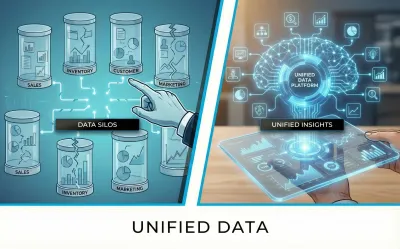
Executive Summary: The AI Readiness Gap
The grocery retail sector operates under acute financial pressure—thin margins, demand volatility, and perishability challenges. Digital transformation and AI adoption are no longer optional, but fragmented data infrastructure is the existential threat preventing scalable AI success.
Core Thesis
Fragmented data is the single largest bottleneck to scalable AI adoption in grocery retail. AI and ML models depend on quality, unity, and timeliness of data. When models train on outdated, incomplete, or fragmented records, personalization lags and operational insights arrive too late. This fragmentation compounds margin pressures from two major cost centers: inventory mismanagement (waste) and labor inefficiency (overstaffing).
Executive AI Optimism
of retail executives recognize the disruptive potential of Generative AI, demanding immediate architectural preparation.
Faster Implementation
Unified platforms deliver 20% faster implementation compared to fragmented multi-vendor stacks.
Better TCO
Total Cost of Ownership is 22% better with unified platforms versus complex legacy integrations.
The Strategic Mandate
Modern grocery leaders must construct a stable, high-integrity foundation upon which AI can deliver scalable, measurable value. The operational reality is that most retailers rely on technological infrastructure designed for a pre-digital era—disconnected legacy systems creating data fragmentation, latency, and integrity issues. The strategic imperative is to eliminate this data debt through unified platform investment.
Current State: Data Dysfunction
Legacy information systems cannot deliver the cohesive, clean, real-time data required by modern AI models. This dysfunction stems from four critical architectural weaknesses that undermine efficiency and strategic planning.
1. Data Gaps & Unity
The Problem: Data silos between POS, ERP, inventory, and workforce scheduling create invisible barriers. Teams rely on non-communicative tools, resulting in partial insights.
The Impact: Systems reflect yesterday's data instead of enabling today's action. High operational costs for storage, maintenance, and reconciliation.
2. Data Integrity & Quality
The Problem: Disparate sources use incompatible schemas, leading to redundancy, inconsistencies, and loss of vital context during integration.
The Impact: Prevents sound decision-making and erodes trust necessary for AI models to operate autonomously and reliably.
3. Grocery-Specific Crisis
The Problem: Cold chain management requires real-time temperature tracking. Traditional batch processing systems cannot provide immediate feedback loops.
The Impact: Data latency equals physical product deterioration and direct financial loss in perishable goods.
4. The Middleware Tax
The Problem: Legacy systems lack modern APIs, forcing reliance on custom middleware. Initial costs: $50K-$500K+, plus 30-50% hidden infrastructure costs.
The Impact: Annual maintenance costs of 15-25% of initial investment. Guaranteed negative ROI funding poor AI performance.
The Architecture: Unified, AI-Native Platform
Overcoming fragmentation requires a fundamental architectural shift toward a unified data platform designed explicitly with AI, real-time velocity, and governance in mind. This defines data as an active operational asset, not a historical archive.
Legacy vs. Unified: Architectural Comparison
| Feature | Traditional Fragmented Systems | Unified AI-Native Platform |
|---|---|---|
| Data Access & Latency | Delayed replication, batch processing, yesterday's data | Real-time continuous streams, unified processing |
| Data Quality & Integrity | Inconsistent, redundant, high manual reconciliation | Single source of truth, automated validation |
| AI Model Infrastructure | Custom pipelines, low scalability, non-native inference | Native model inference, ML-ready vector search |
| Cost Model (TCO) | $50K-$500K+ initial, 15-25% annual maintenance | 22% better TCO over 5 years, predictable costs |
Single Source of Truth (SSOT)
- Unified Processing: Unifies transactional and analytical processing, eliminating replication delays
- Real-Time Operations: Handles structured and unstructured data with continuous information streams
- Native AI Integration: Model inference as native operation, not external service call
Strategic Governance
- Competitive Lever: Consistent policies ensure adaptability and regulatory compliance
- Single Customer View: Comprehensive representation across all touchpoints and channels
- Security & Compliance: Centralized cloud environment provides stronger governance than disconnected nodes
Proof Point 1: Waste & Shrink Reduction
The most immediate financial impact of a unified platform is dramatic reduction in food waste and inventory shrinkage. Given razor-thin operating margins, saving a dollar in cost avoidance is more valuable than generating a dollar in new revenue.
The Economic Burden
Food businesses typically operate on 2-5% profit margins. When inventory disappears due to spoilage, theft, damage, or error, the financial impact is severe. Shrinkage rates of just 1-2% can erase 20-40% of potential net profits. This is compounded by managing highly perishable items with limited shelf life and high demand volatility.
Profit Protection
Eliminate potential net profit loss from spoilage and theft through real-time visibility
Inventory Tracking
Eliminate manual errors, reduce lag time, minimize phantom inventory
Replenishment
Shift from static schedules to real-time, demand-driven restocking
Agile Forecasting & Predictive Logistics
Centralized data enables far more reliable demand forecasts—the prerequisite for preventing costly overstocking (spoilage) and understocking (stockouts). Predictive analytics identify trends and seasonal patterns, enabling informed purchasing decisions and flagging items at risk of expiring. The platform enables agile replenishment by identifying early indicators like sudden regional sales spikes and automatically redistributing stock between stores or modifying supplier orders instantly. This ensures optimized margins with fewer unsold items. AI-driven predictive logistics helps retailers find the critical balance between cost and waste risk, optimizing the entire supply chain.
Proof Point 2: Labor Cost Optimization
Beyond inventory management, a unified platform directly reduces operational costs by streamlining staffing and combating internal loss. This moves workforce management from reactive scheduling to proactive, risk-adjusted labor deployment.
Labor Cost Reduction
Achieved within first year through AI-driven precision staffing
Accuracy Improvement
Better labor cost accuracy through AI scheduling tools
Annual Savings
For typical retailer with $50M revenue through optimized allocation
AI-Driven Workforce Management
Traditional scheduling relies on managerial intuition and historical averages, resulting in costly misalignments. AI-driven WFM platforms sync directly with POS systems, analyzing:
- Transactional data and foot traffic patterns
- Seasonal trends and historical performance
- External factors like weather and local events
This predicts staffing needs with hourly precision, avoiding both overstaffing (inflated costs) and understaffing (lost sales/poor service).
Loss Prevention Intelligence
The unified platform creates a unified intelligence layer combining digital footprints from multiple sources:
- POS transactions and voided sales
- ERP events and inventory counts
- Electronic Article Surveillance (EAS) triggers
- Workforce Management data
This enables real-time fraud detection, identifies "Sweethearting Events," flags suspicious after-hours activity, and strategically optimizes staff placement based on "High Theft Hours" and "Operational Blind Spots."
Case Study: Major U.S. Retailer
A major U.S. retailer achieved $12-13 million in annual benefits after migrating from legacy systems to a modern unified platform. Results included:
- 15% improvement in forecasting accuracy
- Data team redirected from "keep-the-lights-on" operations to high-value analytical insight generation
- Reduced operational complexity by decreasing over 2,000 data elements
Accelerated Decision-Making & Future-Proofing
The shift to a unified platform fundamentally alters organizational capacity for strategic agility, moving from post-mortem analysis to prescriptive action. This prepares the enterprise for the Generative AI era.
Real-Time KPI Discovery
The unified architecture enables instant generation of real-time KPI dashboards—a "performance command center" consolidating data from all transactional systems (POS, ERP, e-commerce) into one reliable SSOT.
Immediate Benefits:
- Real-time inventory tracking and behavior analysis
- Personalized promotions and stock shortage prevention
- Risk management based on dynamic information
- Store staff spot trends and tackle problems without delayed reports
Preparing for Gen AI
Future-proofing requires an architecture that can seamlessly absorb emerging technologies, particularly Generative AI. Retail is shifting toward personalization engines powered by vector search and Large Language Models (LLMs).
Critical Requirements:
- Semantically rich, ML-ready data infrastructure
- Scalable, low-latency processing without custom pipelines
- First-party data activation for targeted advertising
- Robust governance with end-to-end policy controls
The Strategic Warning:
If a retailer fails to establish this unified foundation, they will be structurally unable to feed the necessary, high-quality, comprehensive data streams to future AI models. This effectively cedes future market relevance and the ability to monetize internal data assets to competitors.
The investment in robust data governance, including end-to-end policy controls and observability across pipelines, is essential to ensure security and compliance as these powerful AI systems begin making autonomous, revenue-critical decisions.
Strategic Roadmap for Transformation
To secure compounding financial and strategic benefits, the following three-phase roadmap is recommended for transitioning to a unified, AI-Native data platform.
Phase 1: Audit & Governance Establishment
Objective: Identify all existing data silos, formats, and reconciliation efforts to establish a foundation for unified data management.
Key Actions:
- Initiate comprehensive data governance audit across all systems
- Establish centralized, cross-functional teams to define the SSOT
- Implement rigorous, consistent governance policies organization-wide
- Ensure data standardization and readiness for automated processing
- Document all data flows, dependencies, and integration points
Timeline: 2-3 months | Investment Focus: Internal resources, governance tools, process documentation
Phase 2: Architectural Migration & Simplification
Objective: Migrate core high-velocity transactional systems to a cloud-based, AI-native unified platform.
Key Actions:
- Prioritize migration of POS, WFM, and Inventory systems
- Leverage scalable, low-latency cloud infrastructure
- Drastically reduce reliance on legacy middleware and custom integration debt
- Consolidate data streams and unify transactional/analytical processing
- Implement Customer Data Platform (CDP) capabilities for first-party data
Timeline: 4-6 months | Investment Focus: Cloud platform licensing, migration services, training
Phase 3: Operational Activation & Insight Deployment
Objective: Deploy real-time analytics and advanced predictive models to translate unified intelligence into quantifiable profit gains.
Key Actions:
- Deploy real-time KPI dashboards across all business units
- Implement advanced predictive models for demand forecasting
- Activate dynamic labor scheduling based on real-time data
- Deploy multi-source fraud detection and loss prevention systems
- Ensure unified intelligence layer translates to clear, prioritized store floor actions
Timeline: 3-4 months | Investment Focus: AI/ML model development, analytics tools, user training
Conclusion: The Non-Optional Shift
The analysis demonstrates that the primary bottleneck stifling competitive growth and margin protection in modern grocery retail is architectural debt manifested as data fragmentation. Forcing legacy systems to power complex AI models represents a systemically high Total Cost of Ownership (TCO) that guarantees delayed, inaccurate, and unreliable insights. The high, hidden operational costs of maintaining fragmentation far outweigh the strategic investment required for a unified, AI-Native platform. A fresh, unified approach provides rapid, compounding ROI by strengthening three critical pillars:
- Profit Maximization: Real-time visibility eliminates 20-40% of potential lost profits from spoilage and theft
- Cost Reduction: AI-driven workforce management delivers 5-15% savings on labor costs
- Future Resilience: Establishes ML-ready foundation for Generative AI and retail media monetization
The architectural shift is no longer optional—it is the foundation of survival and competitive advantage in the AI-driven future of grocery retail.
Ready to unify your data?
UniSight provides the unified platform architecture independent grocers need to compete.
Request a Demo