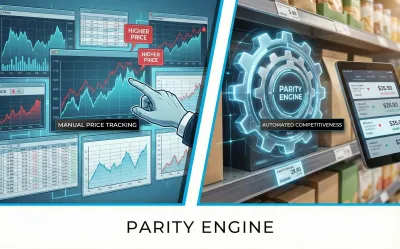
From Existential Threat to Competitive Parity
Independent grocers face an unprecedented crisis defined by structural disadvantages in operational scale and digital transformation speed. Large chains with sophisticated AI have created an efficiency gap that manual operations cannot bridge.
The Critical Pathway
Competitive survival requires achieving operational intelligence parity, not physical scale. The largest competitors—Walmart, Kroger, Albertsons—utilize AI for predictive analytics, dynamic pricing, and supply chain optimization, delivering massive cost savings and superior customer experience. Independent grocers cannot absorb the prohibitive overhead of hiring large analyst teams. The only economically viable mechanism is immediate deployment of a unified, end-to-end AI platform. Such platforms deliver measurable, real-time ROI by eliminating data redundancy, simplifying operations, and fundamentally redefining perishable inventory management.
Food Waste Reduction
Average reduction in food waste with AI-optimized ordering, providing critical financial leverage
Sector-Wide Savings
Estimated financial benefits from AI forecasting implementation, preventing 1M tons of waste
AI Investment Growth
Grocery sector AI spending projected to quadruple by 2025, creating unbridgeable gap
The Competitive Advantage
Strategic adoption transforms the local grocer into a highly agile, data-driven entity capable of securing long-term viability by capitalizing on intrinsic market advantages: superior freshness, quality, and irreplaceable community trust. The elimination of 14.8% food waste provides the financial leverage to compete on value while maintaining premium local sourcing.
The Independent Grocer at a Crossroads
Intense macroeconomic headwinds amplify existing competitive pressures. Inflation drives value-seeking behavior, labor shortages increase costs, and competition from Walmart, Aldi, Lidl, and Costco remains unrelenting.
Financial Divergence: The Efficiency Gap
FY2024 performance comparison reveals widening gap between single-store and multi-store operators
The Stark Reality
Single-store grocers in FY2024:
- Sales decline: -0.8%
- EBITDA: 1.52%
Multi-store operators in FY2024:
- Sales growth: +2.2%
- EBITDA: 3.28% (more than double)
This divergence demonstrates that competitive success is fundamentally about operational efficiency derived from centralized management and optimized processes, not just size. The efficiency advantage translates directly into doubled EBITDA, proving that operational excellence dictates market survival.
Unsustainable Manual Operations
The Problem: Manual tracking and ordering processes are time-consuming and error-prone, creating operational friction that manifests as:
- Severe inaccuracies in inventory management
- Debilitating delays in decision-making
- Capital inefficiency from poor deployment
- Slow responsiveness to consumer trends
- Higher controllable costs and depressed margins
Siloed Technology Trap
The Fragmentation: Typical independent grocers operate with:
- Separate POS terminals
- Manual or semi-automated spreadsheets
- Disconnected accounting software
- Analog security systems
This fragmentation delays fusion of transaction data, inventory counts, and operational observations—losing the ability to react to dynamic perishable goods market shifts.
The AI Chasm: The Giants' Operational Playbook
Large retailers are investing aggressively in AI, creating an operational intelligence gap fundamentally unbridgeable through traditional, human-centric methods alone.
Pillar 1: Hyper-Efficient Operations
Walmart deploys AI-powered robots to continuously monitor inventory and restock shelves.
Whole Foods employs AI cameras for inventory monitoring and stocking level verification.
Computer vision systems and robotics automate shelf audits and restocking alerts, ensuring product availability while drastically minimizing human labor requirements.
Pillar 2: Predictive Forecasting
Kroger (2nd largest) and Albertsons (33 states) leverage big data and ML to predict future demand and associated risks with remarkable accuracy.
This predictive intelligence optimizes inventory levels and entire supply chain logistics, enabling 360° visibility into production, suppliers, and logistics. Optimized systems ensure fuller trucks, reducing transportation costs—an efficiency small operators struggle to match.
Pillar 3: Dynamic Pricing
AI-driven dynamic pricing adjusts prices in real-time based on inventory levels, demand, competitor pricing, and consumer behavior.
Critical for independents: Electronic price tags instantly update to execute timely discounts on overstocked or near-expiry perishables, converting potential waste into recovered revenue. This is primarily a margin protection and sustainability strategy.
Pillar 4: Personalized Experience
AI analyzes comprehensive customer behavior and shopping patterns, enabling targeted discounts and personalized promotions. This hyper-personalized approach strengthens customer loyalty and drives purchase frequency far more effectively than broad marketing campaigns.
The Competitive Parity Gap
AI capabilities of giants versus critical needs of independent grocers
| Operational Function | Chain Grocer AI Application | Independent Grocer Pain Point |
|---|---|---|
| Demand Planning & Forecasting | Deep Learning predicts shifts based on seasonality, promotions, external factors | Manual ordering, high stockouts, significant overstock/waste |
| Pricing Strategy | Dynamic Pricing optimizes margins based on real-time demand, competition, shelf life | Static pricing, margin erosion, inability to quickly liquidate perishables |
| Supply Chain/Logistics | 360° visibility, predictive intelligence, automation (e.g., fuller trucks) | Limited resource visibility, high per-unit costs for ordering and logistics |
| Operational Efficiency | Robotics and integrated vision automate shelf audits and restocking alerts | High labor reliance for monitoring, slow response to shelf voids |