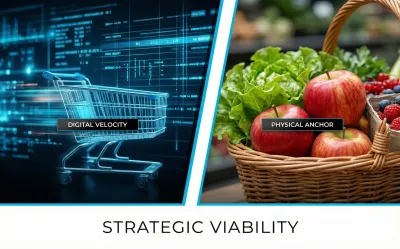
The Shifting Grocery Landscape
Brick-and-mortar resilience vs. digital velocity: The tension between necessity and rapid growth
Only 7.1% of U.S. grocery items sold online (2024)
Digital momentum is real despite in-store dominance
U.S. shoppers still want stores—but experience matters
Grocery's Brick-and-Mortar Anchor
Despite a decade of e-commerce growth, in-store is still the dominant context for U.S. grocery. In 2024, only 7.1% of all grocery item sales occurred online, implying roughly 93% were still transacted through stores. This reinforces brick-and-mortar's continued centrality while acknowledging digital's encroachment.
Preference data points in the same direction: multiple U.S. surveys indicate most shoppers prefer to buy groceries in person (e.g., ~80% reporting an in-store preference; 88% saying they prefer to shop for groceries themselves). The practical implication is clear: shoppers still want stores—but the store must deliver an experience worth the trip.
The Core Challenge: With physical stores capturing ~93% of grocery transactions, the challenge is not sales volume, but rather ensuring the physical experience remains compelling enough to justify the visit over the rising convenience of digital alternatives.
The Acceleration of E-commerce—and the Competitive Threat
Digital's growth curve is steep. In a recent monthly high, U.S. eGrocery captured 17.2% of total grocery spending in July 2025, underscoring the channel's momentum even as stores remain the base. The receiving-method mix continues to evolve: Pickup ~44%, Delivery ~38%, Ship-to-Home ~18% (June 2025).
For independents, the message is clear: compete where the customer plans (online) and win where the purchase happens (in-store). The digital environment excels at convenience and time savings—the top motivations cited by online shoppers—while stores must win on experience, quality, and variety.
Digital Velocity Impact:
While stores capture the majority of transactions, digital's rapid growth (17.2% spending share at peak) signals that independents must adapt quickly by offering unique value propositions that transcend mere stocking and efficiency.
Decoding Channel Preference: Experience vs. Efficiency
Why do shoppers choose one channel over another? U.S. trend work consistently shows convenience and time savings drive online use, while quality, variety, and the in-store experience anchor supermarket preference.
The design takeaway: stores must win on sensory engagement and human connection, not checkout speed. With roughly 80% of U.S. shoppers preferring in-store grocery shopping, the market validates the continued importance of the physical format— provided it delivers an experience worth the trip.
Critical Insight:
The purpose of the brick-and-mortar trip has shifted from transactional necessity to experiential utility. Successful independent grocers must curate an environment that satisfies this psychological and sensory demand, transforming the store into a destination.
U.S. Grocery Channel Dynamics
| Metric | Brick-and-Mortar | E-commerce | Strategic Implication |
|---|---|---|---|
| Primary Channel Today | ~93% of items sold in stores (only 7.1% online in 2024) | Captures spikes in spending share (17.2% in July 2025) | Stores are still the core channel; digital participation is non-negotiable |
| Growth Momentum | Stable base; shoppers still prefer in-person | Fastest growth; method mix: Pickup 44% / Delivery 38% / Ship 18% (June 2025) | Meet planning online; monetize in-store with attachments and experience |
| Preference Drivers | Experience, quality, variety | Convenience and time savings | Make the store experiential and curated, not just efficient |
| Fresh Role / Share | Fresh = 42% of total grocery sales (2024) | 9.3% of fresh sales occur online; 85% of fresh assortments are e-commerce-enabled | The "fresh moat" is narrowing online; emphasize sourcing, service, and prepared foods |
Sources: FMI (Food Industry Facts; State of Fresh Foods 2025); Brick Meets Click/Mercatus; Grocery Dive
The Critical Role of Fresh
Anchor, attractor, and margin pressure: The fresh paradox facing independent grocers
Fresh departments are central to trip generation (2024)
Produce also grew ~4% to $93B in 2024
85% of fresh assortments are e-commerce-enabled
Freshness as the Non-Negotiable Anchor
Fresh departments (produce, meat, deli, bakery) are central to trip generation and banner identity. In the U.S., fresh accounted for 42% of total grocery sales in 2024, affirming its role as a traffic engine.
Within fresh, meat grew +4.7% to $105B and produce nearly +4% to $93B in 2024—strong evidence that shoppers continue to prioritize fresh when they do visit. This high purchase frequency establishes the brick-and-mortar store as a repeated destination, providing the independent grocer with multiple, continuous opportunities to cross-sell higher-margin supplementary goods.
The Traffic Generator: Fresh departments drive consistent foot traffic. The strategic opportunity lies in converting these high-frequency fresh shopping trips into higher-value transactions through effective cross-selling of premium and specialty items.
The Fresh Paradox: Online Has Caught Up on "Good Enough" Fresh
9.3% of fresh sales now occur online, with 85% of fresh assortments e-commerce-enabled
Digital is no longer weak at fresh: 9.3% of fresh sales now happen online, and 85% of fresh assortments are available for e-commerce. Combined with today's fulfillment mix (pickup/delivery dominance: 44%/38%), this erodes the old assumption that brick-and-mortar automatically "wins" on fresh logistics.
The long-standing operational advantage of the brick-and-mortar grocer—superior freshness guaranteed by visual inspection and immediate temperature control— is being rapidly neutralized by digital fulfillment capabilities. The convenience channel is now highly proficient at delivering quality perishables.
The New Reality:
The in-store edge must be sourcing transparency, service, prepared foods, and culinary experiences—not just a promise of freshness. Local grocers can no longer rely purely on fresh quality; they must integrate unique value to maintain the necessity of the in-person visit.
Financial Reality: Flat Margins and Rising Costs
The difficult financial realities facing independent grocers
Limited ability to absorb rising input costs or compete aggressively on price with larger chains
Driven by labor/benefits, card fees, and utilities—creating severe operational pressure
Independent grocers' FY2024 economics are tight. Gross margin held at ~27.4% while total expenses climbed to a record 25.8% of sales, driven by labor/benefits, card fees, and utilities. At the broader industry level, net profit averaged ~1.6% in 2023 and ~1.7% in 2024.
This leaves little room to compete on price. Flat or compressed margins on necessary fresh staples, combined with significant increases in non-discretionary expenses, result in a severe operational deficit. The lever is raising margin dollars per trip.
The Core Operational Challenge:
The current margin structure is unsustainable in this high-cost environment. The strategic focus must shift from relying on fresh items for high volume to optimizing them for high profitability. Independent grocers must generate significantly higher revenue per square foot and per labor hour.
Independent Grocer Profit Drivers & Headwinds (U.S., FY2024)
| Metric / Category | Current State | Impact / Challenge | Required Response |
|---|---|---|---|
| Total Store Gross Margin | ~27.4% | Limited ability to absorb costs or win on price alone | Shift mix to higher-margin specialty & prepared foods |
| Total Expenses | 25.8% of sales (record); labor/benefits key | Profit squeeze per labor hour | AI-assisted labor & inventory; raise sales per labor hour |
| Fresh Department Role | 42% of sales (meat +4.7% to $105B; produce ~$93B) | Fresh drives trips but not enough profit on its own | Use fresh to attach premium complements |
| Digital Context | eGrocery 17.2% spending share (Jul '25); method mix 44/38/18 | Online solved "speed" for perishables via pickup/delivery | Experience-led B&M unified with targeted digital offers |
Sources: FMS/NGA Independent Grocers Financial Study 2025; FMI (State of Fresh); Brick Meets Click/Mercatus; Grocery Dive
This financial strain confirms the core operational challenge: the current margin structure is unsustainable. The strategic focus must shift from relying on fresh items for high volume to optimizing them for high profitability. To cover escalating labor costs and operational overheads, the independent grocer must generate significantly higher revenue per square foot and per labor hour.
The Strategic Pivot:
Since margin compression restricts price increases, revenue must be captured by dramatically increasing the Average Basket Size (ABS) with supplementary, high-margin items.
Key Implications for Independent Grocers
What this means for the future of your business
1. Experience is Non-Negotiable
The physical store must provide an irresistible experiential advantage that digital convenience cannot replicate. Transform from transaction hub to destination.
2. Fresh as Traffic Anchor
View fresh departments not as primary profit drivers but as high-frequency traffic anchors. Leverage guaranteed foot traffic for cross-selling.
3. Basket Size is Critical
With flat margins and rising costs, profitability depends on dramatically increasing Average Basket Size (ABS) through high-margin supplementary items.
4. Differentiation Over Price
Competing on price is not viable. Success requires unique product offerings, local partnerships, and specialized services that command premium pricing.
The Bottom Line
The future viability of the independent grocer hinges on converting the high-frequency fresh shopping trip into a highly profitable transaction. The strategy must move beyond merely satisfying a shopping list to proactively generating impulse purchases and facilitating cross-category exploration.
The Challenge in Numbers
Ready to discover how to overcome these challenges?
UniSight provides the unified platform architecture independent grocers need to compete.
Continue to Part 2: The Solution →