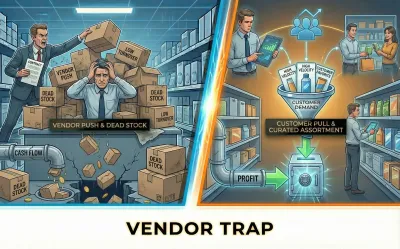
The Inventory Dilemma
The tension between filling shelves and fulfilling customer needs.
The Vendor's Agenda vs. Your Reality
Every independent grocer knows the routine. A vendor walks in with a glossy catalog, a "limited-time" discount, and a pitch for the latest product line extension. Their goal is simple: maximize their footprint on your shelf.
But your goal is different. You aren't in the storage business; you are in the turnover business.
Without consistent processes in place to filter these requests, your store will fast become a warehouse for products that aren't selling. Vendors are incentivized to push volume and variety, often leading to "SKU creep"—where shelves are packed with products that confuse customers rather than converting them.
The Core Challenge:
Vendors want to sell to you. You need to sell through to the customer. When these goals misalign, your capital gets tied up in dead stock, and your most valuable asset—shelf space—is wasted on low-velocity items.
The "Just One More Thing" Strategy
Basket size is everything in your business.
Getting the customer through the front door is the hardest and most expensive part of retail. Once they are inside, the economics shift. The customer has already committed their time; now, your job is to maximize the value of that visit.
Profitability doesn't come from having the most products; it comes from having the right products that trigger that "just one more thing" impulse.
Critical Insight:
If a customer walks in for milk (a low-margin staple) and leaves with only milk, you have merely covered your overhead. If they walk in for milk and leave with milk, a specialty cheese, and a fresh baguette, you have just tripled your margin without increasing your acquisition cost.
Vendor Push vs. Customer Pull
| Metric | Vendor Goal | Retailer Goal | Strategic Implication |
|---|---|---|---|
| Inventory Strategy | Fill every inch of shelf space with their brand. | Optimize shelf space for high-turnover items. | Curate relentlessly. If it doesn't turn, it doesn't earn. |
| New Products | Push "New & More" to hit sales quotas. | Stock only what aligns with customer data. | Implement a "One-in, One-out" policy for new SKUs to prevent clutter. |
| Success Metric | Volume sold into the store. | Basket size and margin out of the store. | Focus on Average Basket Size (ABS), not just total inventory value. |
The Cost of Clutter
Why "More" is often "Less" in retail.
When you buy what the vendor wants you to sell, you often end up with a paralyzed inventory.
Decision Fatigue
Too many options overwhelm shoppers, leading them to stick to basics or walk away empty-handed.
Cash Flow Trap
Every dollar sitting in non-moving inventory is a dollar that cannot be used for labor, upgrades, or high-margin fresh investments.
Operational Drag
It takes labor hours to stock, face, and eventually mark down products that shouldn't have been bought in the first place.
The Operational Pivot:
Stop viewing your shelves as storage for vendors. View them as prime real estate that must pay rent in the form of turnover. If a product doesn't pay its rent, evict it.
Key Implications for Independent Grocers
How to shift from vendor-led to customer-centric.
1. Establish Gatekeeping Processes
Do not allow vendors to stock shelves at will. Implement a strict review process for new items. Ask: "Does this replace a low-performer, or does it complement a high-performer?"
2. Focus on Basket Builders
Analyze your transaction data. Identify which products are frequently bought together. Stock items that naturally encourage the "add-on" purchase (e.g., premium crackers next to the deli, not in the cracker aisle).
3. Data Over Relationships
Your vendor relationships are important, but your customer data is the truth. If the data says a category is stagnant, no amount of vendor enthusiasm should convince you to expand it.
4. Optimize for the "One More Thing"
Design your store layout to interrupt the customer's path with high-margin, irresistible items. The goal is to increase the Average Basket Size (ABS) by just one item per customer. Across thousands of transactions, this is the difference between surviving and thriving.
The Bottom Line
Your vendor wants to fill your shelves. You need to fill your customers' baskets. By shifting your focus from "buying inventory" to "selling solutions," you protect your margins and ensure that every inch of your store is working for you.
Ready to optimize your inventory?
Get a personalized demo and see how UniSight helps you identify what your customers actually want to buy.
Request a Demo